There are seasons in life when the emotional landscape becomes more visible.
This doesn’t always arrive as something dramatic. Often, it appears as increased sensitivity — to people, memories, conversations, or even quiet moments that suddenly feel more meaningful than before.
In these times, the heart does not necessarily “close” or “open” in a single moment. It tends to soften gradually, revealing what has been held, protected, or quietly carried over time.
When emotional awareness begins to deepen
As awareness increases, people often notice shifts in how they relate — not only to others, but to themselves.
Old patterns of holding back, over-giving, or self-protection may become more apparent. At the same time, there can be a growing desire for honesty, ease, and emotional authenticity.
This can feel tender. Sometimes even vulnerable.
Yet it is also a form of clarity — a recognition of where emotional energy flows freely, and where it has become restricted.
Learning to soften without losing boundaries
Opening the heart is not about becoming unguarded or exposed.
It is about restoring movement where things have become tight, and allowing connection without abandoning self-awareness.
This process often unfolds slowly. It is shaped by experience, reflection, and the willingness to stay present with what is emerging rather than rushing to define it.
In these periods, people may find themselves drawn to practices or symbolic objects that feel gentle, comforting, or emotionally grounding.
A mala in this space is often experienced less as a tool, and more as a quiet emotional companion — something that sits close during reflection, meditation, or moments of pause.
Relearning connection
As emotional patterns begin to shift, there is often a subtle rebalancing in how connection is experienced.
Communication may feel clearer. Boundaries may feel more natural. There can be a renewed sense of ease in expressing care without overextending.
This is not about becoming someone different. It is about returning to a more fluid state of emotional presence.
A mala can sit within this process as a reminder of gentleness — not something that changes emotional experience, but something that reflects it back with softness.
Associated mala archetypes
Within this emotional and relational theme, the following mala archetypes are often explored:
- The Nurturer — associated with compassion, emotional healing, and self-kindness
- The Harmoniser — associated with balance in relationships, emotional flow, and inner steadiness
- The Peacemaker — associated with communication, calm expression, and relational clarity
Each mala archetype reflects a different expression of emotional openness — care for self, harmony with others, and clarity in communication.
They are not instructions, but reflections of what may already be present beneath the surface.
A softer way of working with a mala
Some people hold a mala during meditation or journalling. Others keep it nearby as a tactile reminder of gentleness during emotionally active periods.
It does not need to be used in any structured way.
Its presence alone can be enough to evoke a sense of calm continuity — especially when emotions feel more fluid or heightened than usual.
Explore further
If you would like to understand how emotional states connect with broader life transitions, you may find this guide helpful:
👉 Life Phases and Mala Archetypes: Finding What Resonates With You
For a wider framework on choosing a mala during different seasons of life, you may also like:
👉 How to Choose a Mala for Life’s Seasons and Transitions
Featured mala archetypes from this theme
Within this heart-centered energy, you may wish to explore malas associated with emotional balance, compassion, and communication, including:
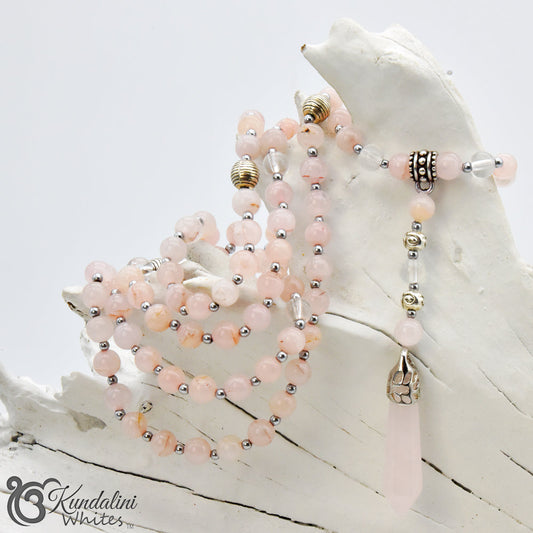
- Rose Quartz & White Agate — The Nurturer
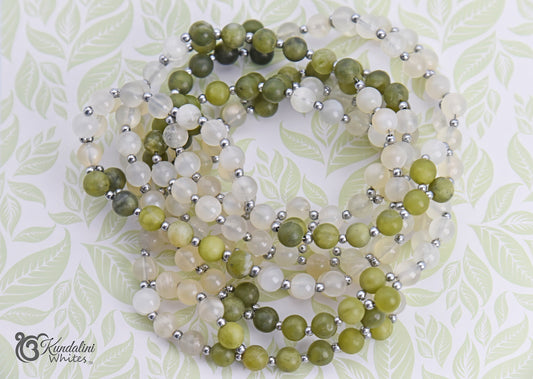
- Green Jade & Moonstone — The Harmoniser
- Blue Lace Agate & Clear Quartz — The Peacemaker
Tags:
Related articles

-
Sep 18 2026
Why Do We Cover the Head in Kundalini Yoga?
-
Jun 25 2026
Your Sadhana, Your Personal Practice
-
Jun 25 2026
Transformation & Personal Growth

-
Jun 25 2026
Grounding During Times of Uncertainty

-
Jun 25 2026
New Beginnings & Fresh Directions
-
Jun 25 2026